

Blog & Resources
Tight Hip Flexors and Front-of-Hip Pain From Sitting: How SoftWave Can Help in Rochester, NY
Sitting All Day in Rochester and Feeling It in the Front of Your Hip?
Think about how many hours you spend sitting. The commute on 490 or 390, a full day at a desk, dinner, and then the couch for a Bills game or a Sabres night. As fall turns into a long Western New York winter, many of us sit even more. And for a lot of people, that shows up as a deep ache or pinch in the front of the hip, stiffness when standing up, and a low back that never quite feels loose.
At Camarata Chiropractic & Wellness in North Chili, Dr. Sam Camarata sees front-of-hip pain from sitting in office workers, remote employees, students, drivers, and weekend athletes who sit all week and then try to play hard on Saturday. This article explains what is going on in the hip flexors, why stretching alone often does not fix it, and how SoftWave Tissue Regeneration Technology (TRT) may help.
Meet Your Hip Flexors
The hip flexors are the muscles that lift your thigh toward your trunk. The main players are:
- Iliopsoas: The psoas starts on the lumbar spine and the iliacus lines the inside of the pelvis. They join and attach to the inner upper thighbone. Because the psoas connects directly to the low back, it influences both hip and spine.
- Rectus femoris: One of the quadriceps muscles, it crosses both the hip and the knee, starting at the front of the pelvis.
- Tensor fasciae latae (TFL): A small muscle on the outer front of the hip that feeds into the IT band.
- Sartorius: A long, thin muscle crossing from the outer hip to the inner knee.
Together they work every time you walk, climb stairs, or get out of a car.
What Sitting Does to the Front of the Hip
When you sit, your hips stay bent at about 90 degrees. Over hours, days, and years, the hip flexors adapt to that shortened position. At the same time, the glutes on the back of the hip sit inactive and can become weak. The result is an imbalance: tight, overworked front muscles and underactive back muscles.
When you finally stand, the shortened hip flexors pull the pelvis forward into an anterior tilt and tug on the lumbar spine. That is why many people feel the front of the hip and the low back at the same time. Over time, the tendons where these muscles attach, especially the iliopsoas tendon and the rectus femoris origin, can become irritated and develop tendinopathy.
Common Symptoms
- Deep ache or pinch in the front of the hip or groin
- Stiffness and pain when standing up after sitting
- Pain lifting the knee, such as getting into a car or putting on socks
- A clicking or snapping sensation in the front of the hip
- Low back tightness that comes along with the hip pain
Why It Lingers
Front-of-hip pain from sitting tends to hang around because the cause never stops. You stretch for five minutes and then sit for nine hours. The irritated tendons have relatively limited blood flow, and constant low-level strain keeps them from fully repairing. Protective muscle guarding adds tension, the glutes stay weak, and the cycle continues. Many people also try to fix the problem with an aggressive weekend workout, which can flare up tendons that were not ready for the load.
Conventional Options and Their Limits
- Stretching the hip flexors helps, but it rarely solves the problem without addressing tendon health and glute strength.
- Standing desks are useful, though standing still all day creates its own problems. Changing positions often is the real goal.
- Anti-inflammatory medications may ease symptoms but do not heal irritated tendons.
- Injections into the iliopsoas area can reduce pain temporarily but do not change mechanics or rebuild tissue.
- Massage and foam rolling can relax the surrounding muscles, though the iliopsoas sits deep in the pelvis and is hard to reach.
That depth is an important point. The iliopsoas is one of the deepest muscles in the body, which is part of why it is so hard to treat effectively with surface-level approaches.
What Our Rochester Patients Are Saying
Real reviews from real SoftWave patients at Camarata Chiropractic & Wellness
How SoftWave Helps Deep Hip Tissue
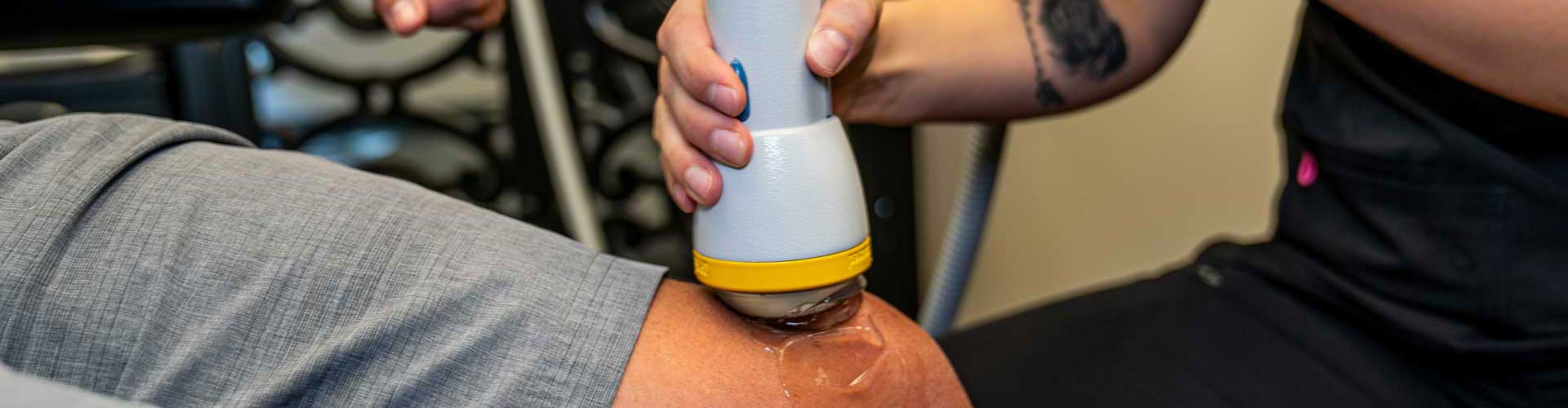
SoftWave uses electrohydraulic technology: a spark in the applicator creates an acoustic wave, and a patented parabolic reflector shapes it into a broad-focused field. It is the only broad-focused shockwave, which allows the energy to reach deep tissue like the iliopsoas tendon while covering a wide area, including the rectus femoris, the TFL, and the surrounding hip structures, in one session.
In plain language, SoftWave is designed to:
- Activate resident stem cells that live in your tissues so true repair can begin.
- Support angiogenesis, the growth of new blood vessels, through VEGF and eNOS pathways, improving blood flow to tendon attachments.
- Encourage proliferation and collagen through signals like PCNA and BMP, helping rebuild healthier tendon fibers.
- Modulate inflammation, including toll-like receptor regulation, so tissue can move out of a stalled, irritated state.
- Clear senescent cells that can slow healing.
If getting up from your desk feels like a project, schedule a SoftWave consultation with Dr. Sam and let us look at your hips, pelvis, and low back together.
SoftWave is FDA-cleared for activation of connective tissue, temporary increase in blood flow, and temporary relief of minor muscle and joint pain, among other uses. Those effects match well with chronically tight, irritated hip flexor tissue.
What to Expect at Our Office
Dr. Sam starts by assessing hip motion, pelvic position, lumbar spine function, and glute strength, and he will ask about your daily sitting habits. Chiropractic care for the pelvis and low back is often part of the plan, since the psoas and lumbar spine are so closely linked.
SoftWave sessions take about 10 to 15 minutes, with no needles, drugs, or downtime, so you can head right back to work. Most patients complete a series over several weeks. Many patients report standing up more easily partway through the series, and because SoftWave is designed to start a healing process, improvement can continue after the final session. For general recovery support, some patients also add our Trifecta full-body Red Light Therapy bed. You can learn more about how we approach care on our Experience Healing page.
Desk Habits That Help
- Stand up and walk for a minute or two every 30 to 45 minutes.
- Do a gentle half-kneeling hip flexor stretch a few times a day.
- Add glute bridges and side-lying leg raises to wake up the back of the hip.
- Set your chair so your hips are level with or slightly above your knees.
When Front-of-Hip Pain Needs Medical Attention
Hip and groin pain can also come from hip arthritis, labral tears, hernias, stress fractures, or problems inside the abdomen. See a physician promptly if you have pain after a fall, inability to bear weight, a groin lump, fever, unexplained weight loss, night pain that does not ease with rest, or numbness and weakness in the leg.
Ready to Stand Up Without the Hip Pinch?
Long days in the chair do not have to leave you stiff and sore. Let us help your hips move and feel the way they should.
Book your SoftWave consultation here
Learn more: SoftWave Therapy for Hip Pain in Rochester, NY
Get a Hold of Us
Ready to get to the root of your pain instead of just managing it?
At Camarata Chiropractic & Wellness, we focus on identifying the root cause of dysfunction and helping your body heal through SoftWave Therapy, Red Light Therapy, chiropractic care, recovery strategies, and lifestyle guidance.
Address: 3237 Union St, North Chili, NY 14514
Phone: 585-617-4145
Email: info@camaratachiropractic.com
Website: https://www.camaratachiropractic.com
Facebook: https://www.facebook.com/camaratachiropractic
Instagram: https://www.instagram.com/camarata_chiro/
Schedule Your SoftWave Therapy Visit Here!
Learn about our newest offering and the powers of red light therapy at RedLightRochester.com.
‹ Back


 3237 Union St,