

SoftWave Therapy for Sciatica in Rochester, NY
Sciatica has a way of taking over your day. It might be a sharp, burning line from your buttock down the back of your thigh, a deep ache in the hip that makes sitting through a meeting or a drive into the city miserable, or tingling that runs all the way into your foot. Many Rochester patients tell us the worst part is not knowing when it will flare next.
At Camarata Chiropractic & Wellness in North Chili, Dr. Sam Camarata helps people sort out where their sciatic pain is really coming from. Along with chiropractic care, we offer SoftWave Tissue Regeneration Technology (TRT), a non-surgical, drug-free option designed to support healing in the irritated tissue that surrounds and crowds the nerve.
Common Sciatica Problems We See
- Disc-related nerve irritation: a bulging or degenerated lumbar disc puts pressure on a nerve root, sending pain down the leg.
- Piriformis syndrome: a tight or irritated muscle deep in the buttock squeezes the sciatic nerve as it passes by.
- SI joint dysfunction: irritation where the pelvis meets the spine can refer pain into the buttock and back of the thigh.
- Spinal stenosis: narrowing around the nerves, often with leg pain that builds with walking and eases when you sit or bend forward.
- Facet joint inflammation: swollen joints at the back of the spine can irritate nearby nerve roots.
- Muscle guarding and tight hips: long hours sitting and stiff hip rotators add tension along the nerve's path.
Why Sciatica Pain Often Lingers
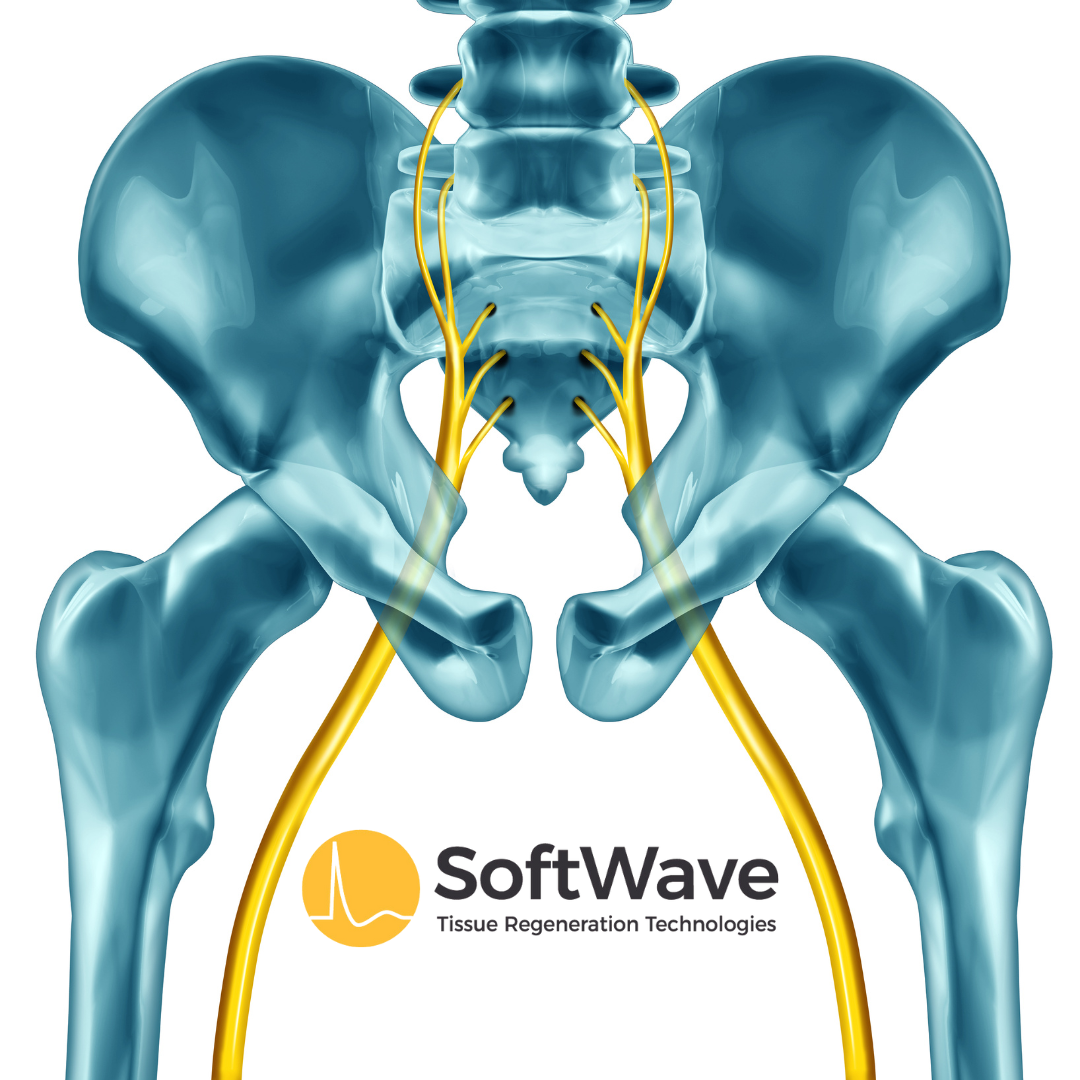
The sciatic nerve is the longest nerve in the body, running from the low back through the buttock and down the leg. Anywhere along that path, swollen or tight tissue can press on it. When the nerve is irritated, the muscles around it often tighten to protect the area, and that tightness adds even more pressure. It becomes a cycle that can drag on for months.
Circulation matters too. Nerves and the connective tissue around them need steady blood flow to calm down and recover. Discs, ligaments, and deep hip tissue do not get much circulation to begin with, so once they are inflamed they can stay stuck in a low-grade, irritated state.
Conventional care usually aims at the symptoms. Anti-inflammatory medication, nerve pain medication, and epidural or cortisone injections may quiet things down for a while. Those approaches have their place, but they are not designed to rebuild the tissue that is crowding the nerve, which is why many people find the pain returns once the effect wears off.
How SoftWave Therapy Helps Sciatica
SoftWave is an electrohydraulic system. A small spark creates acoustic waves, and a patented parabolic reflector shapes them into a broad-focused wave. It is the only broad-focused shockwave technology, which sets it apart from radial pressure wave, electromagnetic, and piezoelectric devices. That broad field lets us address the low back, SI joint, and deep buttock tissue along the nerve's path. In plain language, SoftWave is designed to:
- Calm stuck inflammation: it helps modulate chronic inflammation around irritated tissue, partly through toll-like receptor regulation, rather than simply suppressing it.
- Improve circulation: it supports angiogenesis, the growth of new blood vessels, through signals such as VEGF and eNOS, bringing more blood flow to the tissue around the nerve.
- Activate repair cells: it signals resident stem cells in the area to begin repairing strained discs, ligaments, and muscle.
- Support stronger tissue: markers such as PCNA and BMP are tied to cell proliferation and collagen building in connective tissue.
- Help clear worn-out cells: it supports the clearance of senescent cells that keep tissue stuck in a damaged state.
As tight, inflamed tissue settles and heals, there may be less pressure on the nerve. SoftWave is FDA-cleared for activation of connective tissue, temporary increase in blood flow, and temporary relief of minor muscle and joint pain. Some patients also add our Trifecta full-body Red Light Therapy bed as a complementary recovery option.
What to Expect at Camarata Chiropractic & Wellness
Every sciatica plan starts with a consultation. Dr. Sam will ask where your pain travels, what positions make it worse, and what you have tried so far. He will check your movement, strength, and reflexes to figure out whether the problem is coming from the spine, the SI joint, the piriformis, or a combination. Getting that right is what makes a plan work.
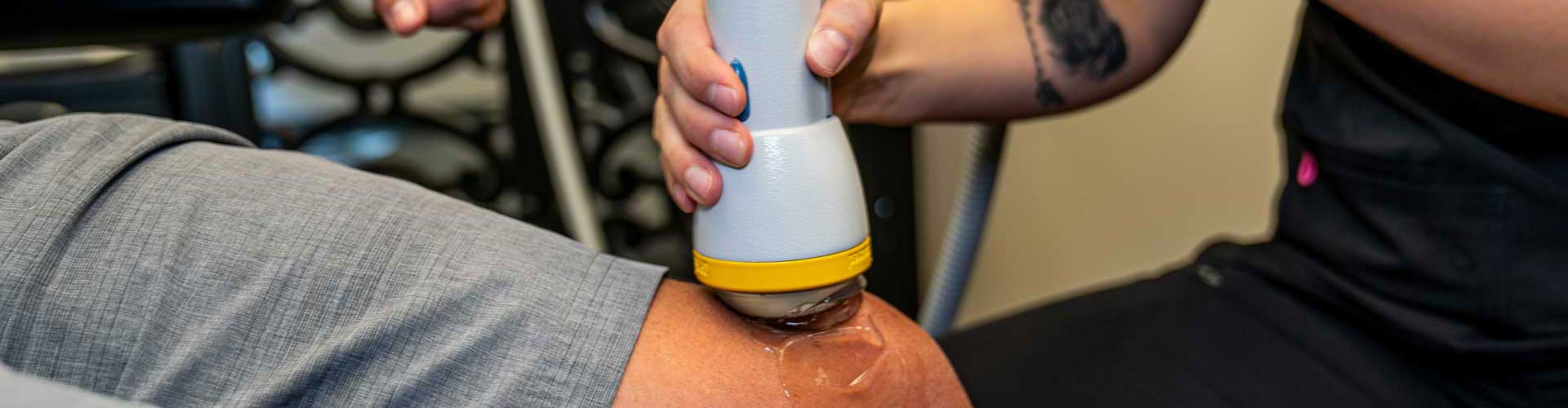
A SoftWave session takes about 10 to 15 minutes. The applicator is moved over the low back, buttock, and sometimes the back of the thigh. Most people describe a tapping or pulsing sensation that feels very manageable. There are no needles, no drugs, and no downtime, so you can head right back to your day.
Most sciatica plans involve a series of sessions over several weeks, often combined with chiropractic care and simple movement strategies. The healing response SoftWave is designed to trigger continues between visits, and many patients report steady, gradual change rather than a single big shift.
If leg pain is keeping you off your feet or out of your favorite chair, book a sciatica consultation with Dr. Sam and learn whether SoftWave could be a good fit.
Sciatica Articles from Our Blog
- Sciatica Pain Relief in Rochester, NY: How SoftWave Therapy Targets the Nerve at the Source
- SI Joint and Sacroiliac Pain in Rochester, NY: The Overlooked Cause of Stubborn Low Back Pain
- Why Are More People in Rochester Choosing SoftWave Therapy Over Pain Meds & Injections?
- SoftWave + Red Light Therapy: Why Stacking These Technologies Accelerates Healing
- Inflamed Tissue Needs Activation, Not Suppression - How SoftWave Activates the Healing Response
- Repair Beats Temporary Relief - The Missing Ingredient: Regenerative Signaling
Frequently Asked Questions
Does SoftWave treat the sciatic nerve directly?
SoftWave focuses on the tissue environment around the nerve: the muscles, ligaments, joints, and connective tissue that may be inflamed or tight. When that tissue heals and settles, many patients report less irritation along the nerve. Dr. Sam will explain what he expects for your specific case.
I was told I have a herniated disc. Can I still try SoftWave?
Many people with disc-related sciatica explore SoftWave as part of a conservative, non-surgical plan. Dr. Sam will review your history and any imaging you have, and he will let you know honestly if another type of care makes more sense first.
How soon might I notice a change?
Every case is different. Some people notice changes within the first few sessions, while others improve more gradually over the full series. Because healing continues after each visit, we look at progress over several weeks rather than day by day.
When is sciatica an emergency?
Seek medical care right away if you have numbness in the groin or inner thighs, new trouble controlling your bladder or bowels, weakness in the leg or foot that is getting worse, or sciatica after a major fall or accident. These signs need urgent evaluation.
Schedule Your SoftWave Consultation in Rochester
You do not have to plan your life around the next sciatica flare. Whether you are in Spencerport or right down the road, we would love to help you find out if SoftWave can help you sit, walk, and sleep more comfortably.
Book your SoftWave consultation today
Camarata Chiropractic & Wellness
3237 Union St
North Chili, NY 14514
Phone: 585-617-4145

 3237 Union St,