

Blog & Resources
Turf Toe and Big Toe Joint Pain: How SoftWave Supports Healing for Rochester Athletes
Big Toe Pain After a Game on Turf? Rochester Athletes, This One Deserves Respect
Turf toe sounds like a minor nuisance, the kind of thing you tape up and play through. Anyone who has actually had one knows better. When the big toe joint is sprained, every push-off, every sprint start, and every lunge sends a sharp reminder up the foot. And because you cannot avoid using your big toe, it can take a frustratingly long time to calm down.
At Camarata Chiropractic & Wellness in North Chili, Dr. Sam Camarata works with football players, soccer and lacrosse athletes, dancers, and weekend warriors from all over the Rochester area. Between fall seasons on synthetic fields and winters spent training in indoor domes, Western NY athletes spend a lot of time on turf. In this article we will explain what turf toe really is, why it heals slowly, what conventional care looks like, and how SoftWave Tissue Regeneration Technology may support your recovery.
What Is Turf Toe?
Turf toe is a sprain of the first metatarsophalangeal joint, the joint where your big toe meets the foot. It happens when the big toe is forced too far upward (hyperextension), usually while the heel is raised and body weight is driving forward. Think of a lineman pushing off, a soccer player getting stepped on from behind, or a runner whose cleat catches the field and jams the toe back.
The Structures Involved
Underneath the big toe joint is a tough band of tissue called the plantar plate, along with the joint capsule, collateral ligaments, and two small bones called sesamoids that sit within the tendon of the flexor hallucis brevis. Together, these structures act like a sling that stabilizes the joint and transfers force when you push off. In turf toe, part or all of that sling is stretched or torn.
Why Turf Makes It More Common
Artificial surfaces tend to be firmer and grippier than natural grass, so the foot sticks while the body keeps moving. Lightweight, flexible cleats offer little protection against the toe bending too far. Put those together and the big toe joint absorbs a lot of force it was not built for.
Grades of Turf Toe
- Grade 1: the plantar complex is stretched. There is local tenderness and mild swelling, and athletes can often keep playing with some discomfort.
- Grade 2: a partial tear. Expect more swelling, bruising, a limp, and painful, limited motion.
- Grade 3: a complete tear of the plantar plate, sometimes with sesamoid injury or joint instability. Walking normally is difficult.
Red Flags
Seek medical evaluation, including imaging, if you cannot bear weight, the toe looks deformed or is drifting upward, there is significant bruising on the bottom of the foot, or the joint feels unstable. These can point to a grade 3 injury, a sesamoid fracture, or a dislocation that may require a boot, casting, or a surgical opinion. Sudden hot, red swelling of the big toe without injury could be gout or infection and also needs medical attention.
Why Turf Toe Lingers
The big toe joint is loaded with every step, so it never gets a true rest unless you are immobilized. Ligament and plantar plate tissue also has a modest blood supply compared to muscle, which slows repair. Many athletes return as soon as the pain fades a bit, re-stress the healing tissue, and end up with weeks of on-and-off pain. A joint that never fully heals can become stiff over time, and a poorly healed big toe sprain may set the stage for later stiffness and arthritis in that joint.
What Our Rochester Patients Are Saying
Real reviews from real SoftWave patients at Camarata Chiropractic & Wellness
Conventional Care and Where It Falls Short
For most grade 1 and many grade 2 injuries, care involves rest, ice, compression, and elevation early on, then protecting the joint from bending upward. That often means taping, a stiff-soled shoe, or a carbon fiber insert, sometimes a walking boot, followed by gradual mobility work and a return-to-play progression. Severe grade 3 injuries may need surgical repair.
Protection is important, but it does not do anything to actively speed up healing. Anti-inflammatory medication may dull pain while doing little for the tissue itself. That leaves many athletes in a gray zone: they are cleared to play but still feel the joint every time they explode off the line.
How SoftWave Helps: The Science Made Simple
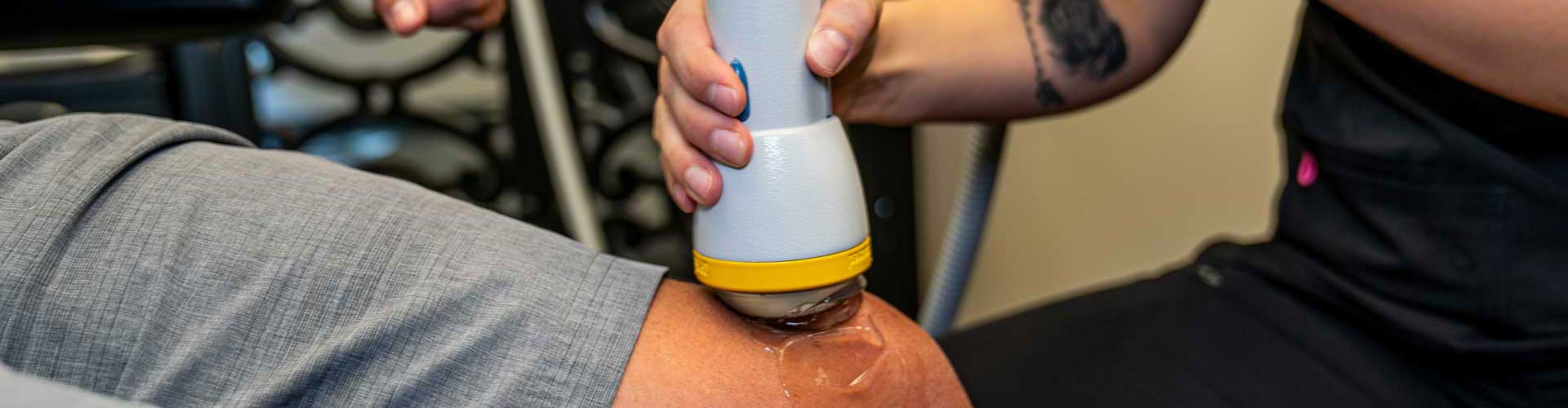
SoftWave uses electrohydraulic technology: a spark generates an acoustic wave, and a patented parabolic reflector shapes it into a broad-focused wave. SoftWave is the only broad-focused shockwave, which is different from radial pressure wave devices that mostly act on the surface and from electromagnetic or piezoelectric systems that converge energy into a narrow point. The broad field can reach the plantar plate, the sesamoid region, and the surrounding capsule in the same treatment.
If your big toe is holding back your season, schedule a SoftWave consultation at Camarata Chiropractic & Wellness and let's map out a plan.
Here is how that broad-focused energy may translate into healing:
- Resident stem cell activation: SoftWave signals the body's own repair cells already present in the joint tissues.
- Better blood flow: stimulation of VEGF and eNOS supports angiogenesis, the growth of new small blood vessels, which helps tissue that normally has limited circulation.
- Collagen production: signals including PCNA and BMP are associated with cell proliferation and new collagen, the building block of ligaments and the plantar plate.
- Inflammation modulation: through toll-like receptor regulation, SoftWave helps the inflammatory phase do its job and then resolve, instead of lingering.
- Senescent cell clearance: it may help clear out worn-out cells so healthier tissue can take their place.
SoftWave has FDA clearance for activation of connective tissue, temporary increase in blood flow, and temporary relief of minor muscle and joint pain, which fits the needs of a sprained big toe joint well.
What to Expect During Treatment
Dr. Sam will start by finding out how and when the injury happened and examining the joint for swelling, tenderness, motion, and stability. If anything suggests a complete tear or fracture, we will recommend imaging and coordinate with the right medical provider before starting.
SoftWave sessions are non-invasive, with no needles, no drugs, and no downtime, so you can usually keep up with practice modifications and conditioning. Each session takes about 10 to 15 minutes. A typical plan is a series of visits over several weeks, and because SoftWave sets off a biological response, healing continues after each session and after the series ends. Many athletes report that push-off feels stronger and less guarded as they progress.
We also look at the rest of the chain. Stiffness in the ankle, limited hip extension, or poor foot mechanics can all change how force lands on the big toe, and chiropractic care may help address those patterns. For athletes juggling a heavy schedule, our Trifecta Red Light bed is an optional complementary way to support overall recovery and circulation between games.
Want to hear from other local patients first? Check out our SoftWave TRT reviews.
Ready to Get Back to Pushing Off With Confidence?
Turf toe does not have to drag on for months or turn into a chronic problem. Let's give that joint the support it needs to heal well.
Book your SoftWave consultation here
Learn more: SoftWave Therapy for Plantar Fasciitis & Foot Pain in Rochester, NY
Get a Hold of Us
Ready to get to the root of your pain instead of just managing it?
At Camarata Chiropractic & Wellness, we focus on identifying the root cause of dysfunction and helping your body heal through SoftWave Therapy, Red Light Therapy, chiropractic care, recovery strategies, and lifestyle guidance.
Address: 3237 Union St, North Chili, NY 14514
Phone: 585-617-4145
Email: info@camaratachiropractic.com
Website: https://www.camaratachiropractic.com
Facebook: https://www.facebook.com/camaratachiropractic
Instagram: https://www.instagram.com/camarata_chiro/
Schedule Your SoftWave Therapy Visit Here!
Learn about our newest offering and the powers of red light therapy at RedLightRochester.com.
‹ Back

 3237 Union St,