

Blog & Resources
Trigger Finger and Nagging Hand Pain in Rochester, NY: A Non-Surgical SoftWave Option
If you’ve ever woken up with a finger bent toward your palm that you have to straighten with a painful snap, you know exactly how disruptive trigger finger can be. That catching, clicking, locking sensation is not just an annoyance. It is a sign that something inside the tendon sheath is inflamed, thickened, and no longer moving freely. For many people in the Rochester area, trigger finger starts as a minor morning stiffness and slowly builds into a problem that limits grip strength, makes everyday tasks frustrating, and eventually raises the question: is surgery really the only option?
The good news is that there are more choices now than there were even a few years ago. At Camarata Chiropractic & Wellness, we work with patients dealing with trigger finger and related hand and thumb tendon conditions using SoftWave Tissue Regeneration Therapy, a non-surgical, drug-free approach designed to work at the tissue level rather than just masking symptoms. If you’ve tried splinting, cortisone shots, or rest with limited lasting relief, this is worth understanding.
Trigger finger is more common than most people realize, and it affects a wide range of people: Rochester tradespeople, carpenters, plumbers, and electricians who grip tools all day; gardeners and crafters who repeat fine hand movements for hours; desk workers and device users whose fingers and thumbs are in near-constant use on keyboards and phones. The condition is not limited to one type of person or one type of activity. What it shares across all these groups is a predictable mechanical problem in the hand.
What Is Actually Happening in the Tendon
The flexor tendons in your fingers run through narrow tunnels called tendon sheaths, held in place by a series of pulleys. The first of these pulleys, the A1 pulley, sits at the base of each finger right at the palm. When that pulley or the tendon itself becomes inflamed and thickened, the tendon no longer slides smoothly through the sheath. Instead it catches, clicks, or locks in place.
The result is the classic trigger finger presentation:
- A finger or thumb that clicks or snaps when bent or straightened
- Stiffness and soreness at the base of the affected finger, especially in the morning
- A tender nodule or lump at the palm side of the finger joint
- A finger that locks in a bent position and requires effort or force to straighten
- Worsening discomfort with gripping or repetitive hand use
The medical name for this condition is stenosing tenosynovitis. The word “stenosing” refers to narrowing, and that is exactly what happens: the available space for the tendon tightens, creating friction, inflammation, and over time, more thickening. It can become a self-reinforcing cycle.
Why Standard Treatments Often Fall Short
The most common conventional treatments for trigger finger each address a piece of the problem without resolving the underlying tissue issue.
Splinting
Splinting the finger in an extended position reduces movement and gives inflamed tissue a chance to calm down. For mild or early-stage cases, this can be helpful. But the relief often fades once the splint comes off and normal activity resumes, because the structural changes in the tendon and pulley have not been addressed.
Corticosteroid Injections
Cortisone shots are a common next step. They can reduce inflammation quickly and many patients feel significant relief. The limitation is that cortisone suppresses inflammation rather than resolving the tissue damage underneath it. Relief may last weeks to months, but repeat injections carry their own risks, including tendon weakening over time. Many patients find that the relief shortens with each injection.
Surgery
When conservative measures fail, surgical release of the A1 pulley is typically offered. The procedure is generally straightforward, but it does involve incision, recovery time, the possibility of stiffness, and the risks that come with any surgical intervention. For many patients, especially those with other health considerations, surgery feels like an extreme step for a tendon problem.
What Our Rochester Patients Are Saying
Real reviews from real SoftWave patients at Camarata Chiropractic & Wellness
SoftWave and the Tendon: What the Technology Is Designed to Do
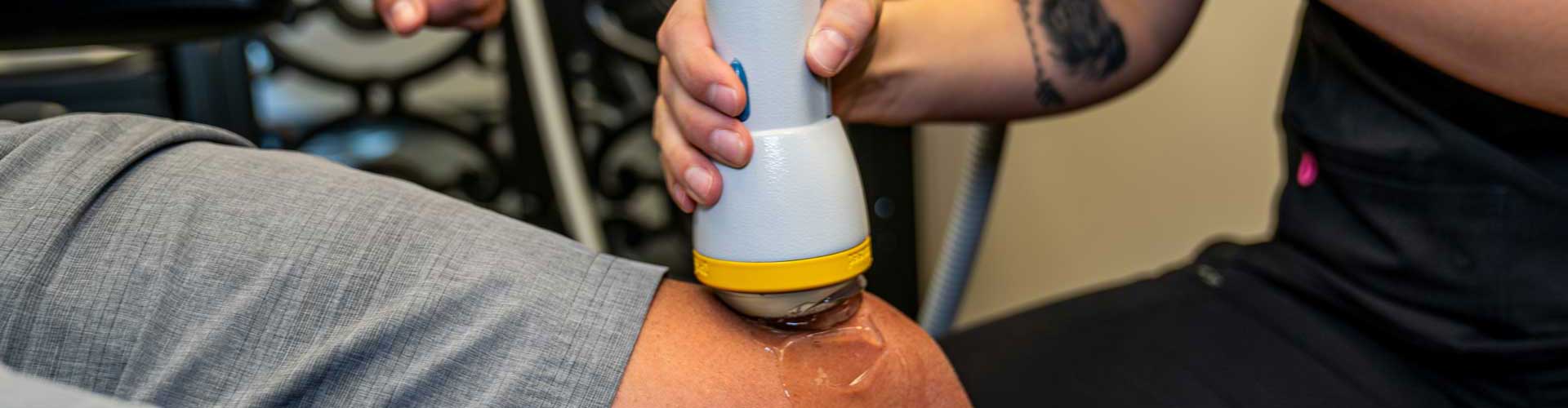
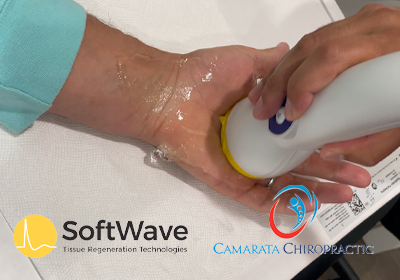
SoftWave Tissue Regeneration Therapy uses electrohydraulic extracorporeal shockwave technology to deliver a broad-focused acoustic wave into the tissue. This is not ultrasound and it is not laser. The waves create a mechanical signal at the cellular level through a process called mechanotransduction, essentially telling the tissue that repair work needs to happen.
In a tendon environment like the one involved in trigger finger, SoftWave is designed to:
- Modulate the inflammatory response, shifting it from a chronic, stuck state toward a productive, repair-oriented one
- Activate resident stem cells in and around the tendon and surrounding tissue
- Support new blood vessel formation (angiogenesis) to improve circulation in an area that may be chronically under-supplied
- Encourage collagen remodeling, which may help address the thickening and fibrotic changes in the tendon sheath
- Break up fibrotic adhesions that are contributing to restricted tendon movement
The key distinction from cortisone is this: SoftWave does not suppress inflammation. It modulates it, nudging the tissue from a dysfunctional chronic state into a state where the body’s own repair processes can actually do their job. Many patients report that this distinction matters in terms of how lasting the results feel compared to injection-based relief.
If you’re curious whether SoftWave might be appropriate for your hand or finger condition, the next step is a one-on-one evaluation. Book a SoftWave consultation at Camarata Chiropractic & Wellness to find out where you stand.
De Quervain’s and Related Thumb and Wrist Tendon Conditions
Trigger finger is not the only overuse tendon condition we see in the hand. De Quervain’s tenosynovitis is a related problem that affects the tendons on the thumb side of the wrist, causing pain and swelling just above the wrist when gripping, pinching, or turning the hand. Like trigger finger, it involves tendon irritation inside a tight sheath, and like trigger finger, it is often addressed with splinting and cortisone before surgery is considered.
Many patients dealing with trigger finger also have some thumb-side wrist involvement, particularly those whose work or hobbies require repeated pinching or lateral thumb movement. SoftWave’s ability to work across a treatment area rather than at a single pinpoint makes it a practical option for addressing adjacent tissue involvement in the same session.
Who Tends to Benefit Most
SoftWave is not appropriate for every patient or every stage of trigger finger, and we will always be upfront about what we think is a reasonable expectation. That said, the patients who tend to respond best share some common characteristics:
- Mild to moderate trigger finger with clicking, catching, or morning stiffness that has not progressed to a fully locked finger
- Patients who have had temporary relief from cortisone but are looking for something that may last longer without repeated injections
- Those who want to exhaust non-surgical options before committing to a procedure
- People who cannot easily afford extended downtime from work or daily responsibilities
- Patients managing other hand or tendon conditions simultaneously, such as De Quervain’s or general overuse irritation
Patients with very advanced or severe locking, structural joint damage, or significant nerve involvement may need a different path, and we will discuss that honestly during the evaluation.
What a SoftWave Plan for Trigger Finger Looks Like
A typical plan involves a series of SoftWave sessions over several weeks, with treatment applied directly to the affected tendon area at the base of the finger or along the thumb-side wrist for De Quervain’s cases. Sessions are brief and do not require anesthesia, incisions, or any recovery period afterward. Most patients return to normal activity the same day.
We also look at the whole picture: grip patterns, activity load, whether activity modification during the initial treatment period makes sense, and whether chiropractic care addressing the wrist, forearm, or shoulder might contribute to better outcomes. Hand and finger tendon problems rarely exist in a vacuum, and a broader look at the mechanics often reveals contributing factors worth addressing.
You can hear from patients who have gone through our care at our SoftWave TRT reviews page, and for a broader look at what the experience here is like, the Experience Healing section of our site gives a good sense of what to expect from your first visit through your ongoing care plan.
A Practical Option Before Surgery for Rochester Patients
If you live and work in Rochester, North Chili, Chili, Greece, Gates, Spencerport, or anywhere in the surrounding area, and you’re dealing with trigger finger or nagging hand and thumb pain that has not responded well to conservative care, SoftWave is worth a conversation. It is not a promise of a cure, and no responsible provider will frame it that way. What it is: a technology designed to work with your body’s own repair biology rather than around it, with a track record in tendon and soft-tissue conditions that gives it a legitimate place in the conversation before surgery enters the picture.
Ready to Get Started?
If you’re dealing with chronic pain in Rochester, Chili, Churchville, Spencerport, Gates, Greece, Hilton, Rush, Henrietta, Scottsville, Caledonia, LeRoy, Brighton, or anywhere in the greater Rochester area, we’d love to help you find a path that works with your body, not against it.
Book your consultation here and let’s build a plan around what your tissue actually needs.
Get a Hold of Us
Ready to upgrade your health from the inside out?
At Camarata Chiropractic & Wellness, we focus on identifying the root cause of dysfunction and optimizing your body’s performance through SoftWave Therapy, Red Light Therapy, chiropractic care, recovery strategies, and lifestyle guidance.
Address: 3237 Union St, North Chili, NY 14514
Phone: 585-617-4145
Email: info@camaratachiropractic.com
Website: https://www.camaratachiropractic.com
Facebook: https://www.facebook.com/camaratachiropractic
Instagram: https://www.instagram.com/camarata_chiro/
Schedule Your New Patient Special Here!
Learn about our newest offering and the powers of red light therapy at RedLightRochester.com.
‹ Back



 3237 Union St,