

Blog & Resources
Swimmer's Shoulder in Rochester, NY: Healing Overhead Pain From Pool and Lake Season
Swimmer's Shoulder in Rochester: When Pool Laps and Lake Swims Start to Hurt
Summer in Rochester pulls people into the water. Masters swimmers who logged laps all winter at indoor pools finally head outside, triathletes start open-water practice at Durand Eastman and along the Lake Ontario shoreline, and families spend long afternoons at Finger Lakes cottages swimming out to the dock and back. For a lot of those swimmers, the season comes with an unwelcome companion: a deep, nagging ache at the front or top of the shoulder that shows up with every stroke.
At Camarata Chiropractic & Wellness in North Chili, Dr. Sam Camarata sees this pattern every summer. "Swimmer's shoulder" is not one single injury, but a group of overuse problems that come from repeating the same overhead motion thousands of times. It usually responds well to a smart plan, and SoftWave Tissue Regeneration Technology (TRT) gives us a non-invasive way to help irritated tendons heal rather than just rest.
What "Swimmer's Shoulder" Really Means
The shoulder is built for mobility, not stability. The ball of the upper arm sits on a shallow socket held in place mostly by soft tissue: the rotator cuff, labrum, joint capsule, and shoulder blade muscles. Swimming takes those structures through a huge range of motion on every stroke.
Most swimmer's shoulder pain involves some combination of:
- Rotator cuff tendinopathy, most often the supraspinatus tendon, which runs under the bony roof of the shoulder (the acromion)
- Biceps tendon irritation at the front of the shoulder, where the long head of the biceps runs through a groove in the upper arm bone
- Subacromial bursitis, inflammation of the small fluid sac that cushions the tendons under the acromion
- Shoulder blade fatigue, which lets the joint drift into pinched positions
Swimmers often describe pain when the hand enters the water and reaches forward, during the "catch" as they start to pull, or when lifting the arm overhead outside the pool.
Why Swimmers Are So Prone to It
Volume adds up fast
Even a moderate workout means hundreds of shoulder rotations per arm. Over several sessions a week, small stresses accumulate faster than tendons can remodel, and tendons, with their limited blood supply, adapt slowly compared with muscle.
Technique and breathing habits
A few common stroke habits load the front of the shoulder heavily:
- Crossing the midline when the hand enters the water
- A dropped elbow during the catch, which shifts the work from the back and lats to the front of the shoulder
- Breathing only to one side, which can create uneven body roll and overload one arm
Rochester's seasonal jump
Many Western NY swimmers barely swim from October through May, then jump straight into long lake swims or triathlon training when the water warms up. Open water adds chop, sighting, and wetsuit resistance, and that sudden spike in demand is a story we hear every July.
Why It Hangs Around
Many swimmers take a week or two off, come back, and feel the same pain within a few sessions. Rest calms inflammation but does not necessarily rebuild the tendon. Chronic tendon problems involve disorganized collagen fibers and reduced circulation, so the tissue is less "inflamed" than stuck in a poor healing state.
Meanwhile, swimmers compensate by shortening their reach or shrugging the shoulder, which can keep the tendon in a compromised position and strain the neck and upper back.
Conventional Options and Their Limits
Standard approaches usually include rest, ice, anti-inflammatory medication, physical therapy, and sometimes a corticosteroid injection. Each has a place:
- Rest, ice, and anti-inflammatories can calm a flare, but do little to rebuild tendon quality.
- Exercise-based rehab is genuinely important and part of nearly every good plan.
- Steroid injections can quiet pain quickly, but repeated injections near tendons are approached with caution because of concerns about tissue quality.
What many swimmers are missing is something that directly supports the tendon's healing biology while they work on strength and technique.
What Our Rochester Patients Are Saying
Real reviews from real SoftWave patients at Camarata Chiropractic & Wellness
How SoftWave Helps the Swimmer's Shoulder
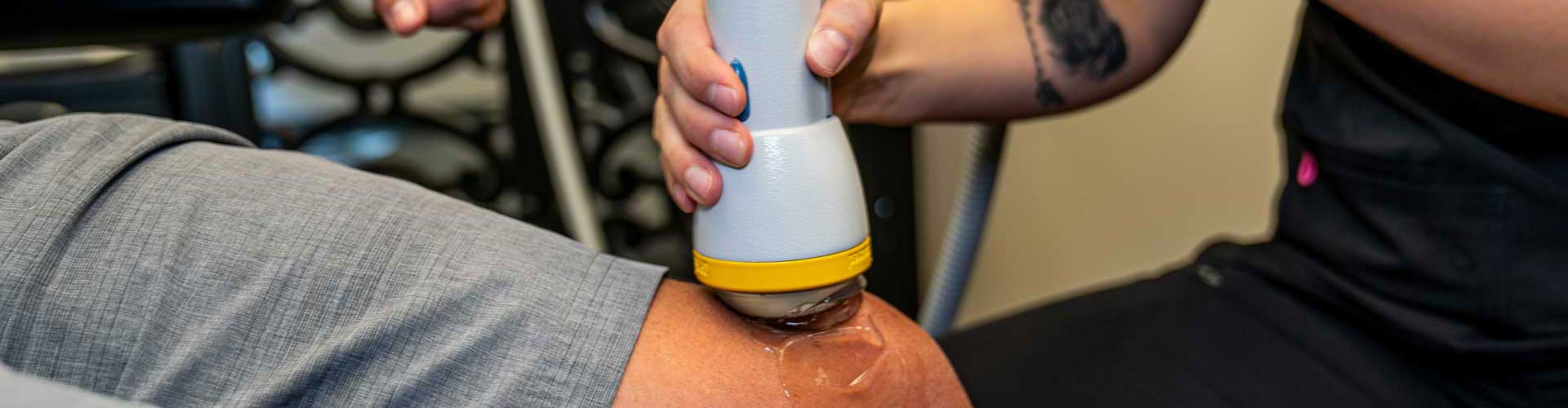
SoftWave TRT uses electrohydraulic technology: a small spark generated in water creates an acoustic wave, and a patented parabolic reflector shapes it into a broad-focused wave. Unlike radial devices, whose energy fades near the surface, or electromagnetic and piezoelectric devices that focus on a narrow point, SoftWave is the only broad-focused shockwave, so it can treat the whole rotator cuff region and front of the shoulder in one session.
SoftWave is FDA-cleared for activation of connective tissue, temporary increase in blood flow, and temporary relief of minor muscle and joint pain.
In plain language, here is what that acoustic energy is designed to do:
- Activate resident stem cells already present in the tissue
- Support new blood vessel formation (angiogenesis) through pathways involving VEGF and eNOS, which matters for poorly supplied tendons
- Encourage cell proliferation and collagen production, with markers like PCNA and BMP involved in rebuilding tissue
- Modulate inflammation, partly by regulating toll-like receptors
- Help clear senescent cells, the worn-out cells that can keep chronic tissue stuck
If your shoulder has been barking every time you swim, schedule a SoftWave consultation with Dr. Sam and we will take a close look at what is actually irritated.
What to Expect at Camarata Chiropractic & Wellness
Your first visit starts with a conversation about your swimming: how often, which strokes, pool or open water, and when the pain began. Dr. Sam will assess range of motion, rotator cuff strength, shoulder blade control, and the upper back, since stiffness there often feeds shoulder problems.
SoftWave sessions typically take about 10 to 15 minutes. There are no needles, no drugs, and no downtime, so many swimmers keep training in a modified way. Most plans involve a series of sessions over several weeks, and because SoftWave is designed to kick off a healing response, that process continues between and after visits. Many patients report noticing changes early in the series, though everyone responds differently.
Alongside SoftWave, we may use chiropractic care for the upper back and ribs. Some swimmers also add our Trifecta Red Light bed as a complementary option to support circulation and recovery during heavy training weeks.
Smart habits while you heal
- Cut volume rather than stopping completely, if pain allows
- Work on bilateral breathing and full body rotation
- Skip hand paddles until the shoulder settles
- Add rotator cuff and shoulder blade strengthening on dry land
When to Get Checked Right Away
Most swimmer's shoulder is an overuse issue, but some symptoms deserve prompt medical attention. See a physician or urgent care if you have sudden weakness or inability to lift the arm after a specific injury, a visible deformity, numbness or tingling running down the arm, pain with fever or redness, or chest pain or shortness of breath with arm pain. SoftWave is a complement to good medical judgment, not a replacement for it.
You can read what other local patients have shared on our SoftWave reviews page.
Ready to Get Back in the Water?
Whether your goal is a summer of easy lake swims or a strong finish at your next triathlon, a shoulder that heals properly makes every stroke easier. Let Dr. Sam help you build a plan that fits your season.
Book your SoftWave consultation here
Learn more: SoftWave Therapy for Sports Injuries in Rochester, NY
Get a Hold of Us
Ready to get to the root of your pain instead of just managing it?
At Camarata Chiropractic & Wellness, we focus on identifying the root cause of dysfunction and helping your body heal through SoftWave Therapy, Red Light Therapy, chiropractic care, recovery strategies, and lifestyle guidance.
Address: 3237 Union St, North Chili, NY 14514
Phone: 585-617-4145
Email: info@camaratachiropractic.com
Website: https://www.camaratachiropractic.com
Facebook: https://www.facebook.com/camaratachiropractic
Instagram: https://www.instagram.com/camarata_chiro/
Schedule Your SoftWave Therapy Visit Here!
Learn about our newest offering and the powers of red light therapy at RedLightRochester.com.
‹ Back

 3237 Union St,